7 Tips for Choosing a Home Shop CNC Machine
Choosing a home shop CNC machine is not simply a matter of buying the largest router or mill available. The right machine must match your materials, workspace, electrical supply, software skills, and production goals. A compact benchtop mill may handle aluminum brackets well, yet struggle with steel, dust, or continuous cutting. That difference becomes obvious when a quiet garage turns into a hot, vibrating workspace.
Industry data shows why careful selection matters. The Association for Manufacturing Technology’s U.S. Manufacturing Technology Orders reports track billions of dollars in annual machine-tool investment, reflecting continued demand for automated production equipment. The International Federation of Robotics also reported 541,302 industrial robots installed worldwide in 2023, confirming the broader movement toward accessible automation. These figures describe industrial environments, not home workshops. Still, they reveal an important trend: machine capability increasingly depends on integration, control, maintenance, and operator skill.
A reliable home shop cnc machine should therefore be judged beyond spindle speed and advertised travel. Check rigidity, repeatability, controller support, tooling cost, enclosure quality, and service availability. A machine that looks affordable may require expensive upgrades, dedicated circuits, or stronger dust collection. The hidden costs matter.
Small details matter most.
These seven tips focus on practical decisions that product pages often overlook. They also recognize an uncomfortable truth: beginners may select impressive specifications before understanding their actual projects. That is not failure. It is a reason to compare evidence, inspect real user results, and leave room for learning. As reports from AMT, IFR, and established machine-tool manufacturers suggest, productive automation depends on the complete system, not one headline specification.
Set the Work Envelope with 10–20% Clearance Beyond Your Largest Stock
7 Tips for Choosing a Home Shop CNC Machine
Set the Work Envelope with 10–20% Clearance Beyond Your Largest Stock
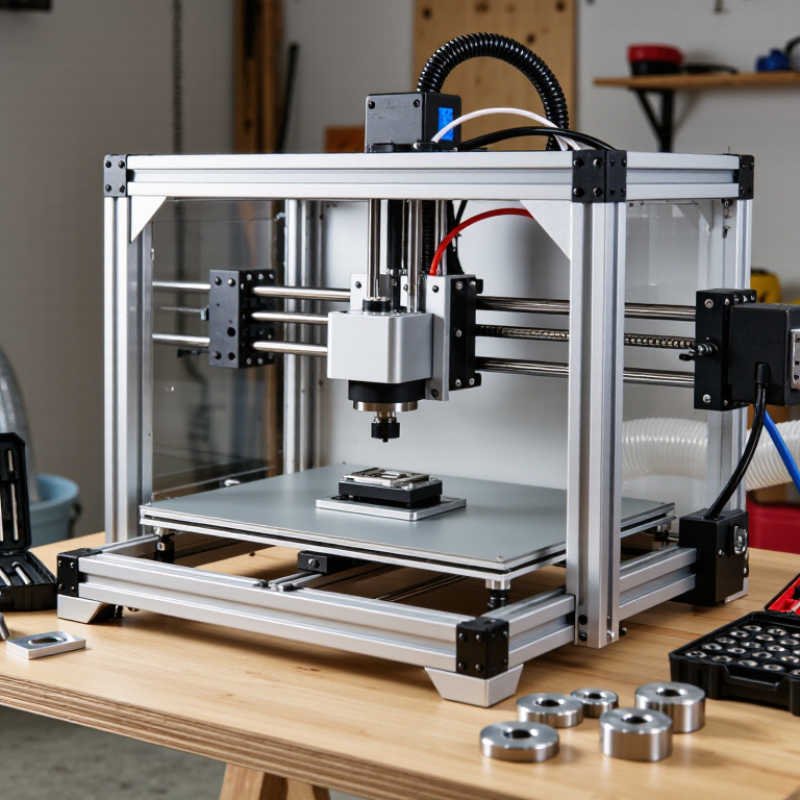
The work envelope should exceed your largest stock by 10–20% on every important axis. For a 24-inch panel, target 26.4–28.8 inches of usable travel. This space accommodates clamps, fixtures, tool paths, and safe approach angles. The advertised travel is not always usable travel. Motors, limit switches, and machine frames can reduce it.
I once measured only the raw material. That was a mistake. A 20-inch board needed a fixture plate, side clamps, and clearance for a dust shoe. The cutter could reach the board, but the machine could not complete the planned operation comfortably. Leave room for awkward setups. You may need it sooner than expected.
The 2023 U.S. Manufacturing Technology Orders report from AMT recorded approximately 4.9 billion dollars in machine tool orders. That investment reflects growing demand for flexible production, even among smaller workshops. However, more capacity does not automatically mean better results. A large envelope can still waste floor space and reduce rigidity. Check the manufacturer’s dimensional drawings, not only the headline specifications. Measure usable X, Y, and Z travel with your actual workholding installed. Remember cable loops, enclosure doors, and emergency access. The 10% minimum can work for simple flat parts. Complex fixtures may require closer to 20%. My own estimate would be more cautious next time.
7 Tips for Choosing a Home Shop CNC Machine - Set the Work Envelope with 10–20% Clearance Beyond Your Largest Stock
Use the largest material you expect to machine as the baseline. A usable work envelope that is approximately 10% larger provides a practical minimum, while 20% additional capacity gives more room for positioning, workholding, and future projects.
| Largest Stock Size (X × Y × Z) | 10% Minimum Envelope | 20% Comfortable Target | Typical Suitable Projects | Planning Note |
|---|---|---|---|---|
| 12 × 12 × 1 in | 13.2 × 13.2 × 1.1 in | 14.4 × 14.4 × 1.2 in | Small signs, panels, templates, and hobby parts | A compact machine may be adequate, but check clamp and fixture space. |
| 24 × 12 × 1 in | 26.4 × 13.2 × 1.1 in | 28.8 × 14.4 × 1.2 in | Long plaques, cabinet components, and instrument panels | The long axis usually determines the machine footprint. |
| 24 × 24 × 1 in | 26.4 × 26.4 × 1.1 in | 28.8 × 28.8 × 1.2 in | Medium signs, furniture parts, and layered assemblies | Confirm that the stated dimensions are usable travel, not only table size. |
| 48 × 24 × 1 in | 52.8 × 26.4 × 1.1 in | 57.6 × 28.8 × 1.2 in | Large signs, cabinet doors, and full-size layout work | A long-bed design or indexing strategy may be required. |
| 12 × 6 × 2 in | 13.2 × 6.6 × 2.2 in | 14.4 × 7.2 × 2.4 in | Relief carving, thicker plastic parts, and small aluminum work | Z clearance must account for the stock, fixture, and tool length. |
| 18 × 18 × 3 in | 19.8 × 19.8 × 3.3 in | 21.6 × 21.6 × 3.6 in | Deep fixtures, foam patterns, and three-dimensional prototypes | Verify spindle clearance and the maximum safe tool stick-out. |
| 36 × 18 × 0.5 in | 39.6 × 19.8 × 0.55 in | 43.2 × 21.6 × 0.6 in | Decorative panels, thin sheet goods, and repeated production layouts | For thin materials, rigidity and reliable workholding can matter more than Z travel. |
Recommended envelope = largest stock dimension × 1.10 to 1.20.
Compare the stock size with actual X, Y, and Z cutting travel rather than the outside table dimensions.
Leave additional room when clamps, a vacuum fixture, a spoilboard, or an indexing reference will be used.
Dimensions are shown in inches and rounded to one decimal place. The 10–20% allowance is a planning guideline; the final machine choice should also consider rigidity, spindle capacity, material thickness, workholding method, and available floor space.
Match Spindle Power, Speed, and Tooling to Wood, Plastic, and Aluminum
7 Tips for Choosing a Home Shop CNC Machine
Tip 1
Match spindle power to the material, not the machine’s maximum rating. Wood usually cuts well with moderate power and sharp carbide tools. Plastic needs controlled heat, because melting can ruin an otherwise clean edge. Aluminum demands more rigidity, slower engagement, and stable chip removal. A powerful spindle cannot fix a flexible frame.
Tip 2
Choose useful speed control. High RPM helps small cutters in wood, but it can soften plastic quickly. Aluminum often needs lower speeds, shallow passes, and steady feed rates. Listen to the cut. A squeal may signal heat, vibration, or a dull tool. I have sometimes blamed the material first, then discovered poor chip clearance. That mistake is common.
Tip 3
Inspect the tooling system before buying. Check collet sizes, cutter availability, and runout. Short, rigid tools reduce vibration. Use single-flute cutters for some plastics, while two-flute carbide tools often suit wood and aluminum. Keep separate cutters for different materials. Tiny chips can scratch delicate surfaces.
Tip 4
Test your setup with scrap material. Record spindle speed, feed rate, depth, and chip appearance. These notes become more valuable than generic settings. Leave room for adjustment; home workshops rarely have perfect dust control, temperature, or rigidity. A machine that cuts slowly and predictably may outperform a faster one in daily use.
Verify Accuracy Through ISO 230-2 Testing and Repeatability Specifications
7 Tips for Choosing a Home Shop CNC Machine
Accuracy claims need evidence, not attractive numbers. Ask for an ISO 230-2 positioning test report before purchasing. ISO 230-2 separates positioning accuracy from repeatability, which are different performance measures. Accuracy describes closeness to the commanded position. Repeatability shows how consistently the machine returns there. That distinction matters when drilling a second batch of parts. A machine may repeat well while still missing the programmed coordinate.
Check the test conditions carefully. The report should identify axis travel, target positions, approach direction, temperature, measurement equipment, and uncertainty. NIST Technical Note 1297 explains that expanded uncertainty commonly uses a coverage factor of k=2, representing roughly 95% coverage. Without uncertainty, a stated 0.01 mm result may look more certain than it is. Look for bidirectional results, not only one-way measurements. Backlash can hide in a one-direction test.
I once trusted a repeatability figure measured after a short warm-up. That was a mistake. The first aluminum parts shifted slightly as the spindle and frame warmed. Test again after realistic operating time. Use your own indicator or probe when possible. Compare ten repeated moves at several positions. Record the spread. Small shops often accept vague specifications. Do not. A clear ISO 230-2 report, sensible uncertainty data, and repeatability results under working conditions provide a more reliable buying decision.
Evaluate Frame Rigidity, Linear Rails, Leadscrews, and NEMA 23 Motors
Tip 1: Check frame rigidity before chasing speed. A heavy steel or well-braced aluminum frame resists vibration during cutting. Grand View Research’s 2024 CNC machine analysis valued the global market near 86 billion dollars in 2023, but market growth does not guarantee home-shop quality. Tap the frame lightly. A dull response is preferable to a sharp ringing sound.
Tip 2: Inspect the linear rails and leadscrews closely. Profiled rails should feel smooth, without side play or gritty movement. Leadscrews need proper support at both ends. Backlash can ruin small holes and fitted parts. ISO 230-2 separates positioning accuracy from repeatability, a useful distinction when comparing machine specifications. I once trusted a low backlash figure and ignored mounting quality. That was a costly mistake.
Tip 3: Treat NEMA 23 as a frame size, not a performance rating. Motor torque, winding inductance, drive current, and power supply voltage matter more. A 2024 MarketsandMarkets report identifies automation and precision production as major CNC growth drivers, yet home users often oversize motors without matching the drive. Test cutting torque at realistic speeds. Look for missed-step evidence, not impressive brochure numbers. Leave room for doubt. A machine that cuts quietly and repeats accurately is usually more valuable than one with a larger advertised motor.
7 Tips for Choosing a Home Shop CNC Machine
Evaluate frame rigidity, linear rails, leadscrews, and NEMA 23 motors before comparing price or cutting speed.
The chart shows practical evaluation weights for a compact home-shop CNC machine. Frame rigidity receives the highest weight because it limits vibration and dimensional accuracy. Linear rails should be appropriately sized and preloaded, while a 5 mm leadscrew pitch is a common reference for balancing speed and positioning control. NEMA 23 motors are widely used in this class of machine, but their available torque must be matched to screw pitch, acceleration, and cutting load.
Audit Safety, Dust Control, Software Compatibility, and Total Ownership Cost
7 Tips for Choosing a Home Shop CNC Machine
Tip 1: Audit safety before comparing cutting speed. Check emergency stops, enclosed moving parts, stable frames, and clear access to controls. Leave space around the machine for maintenance and unexpected movement. A rushed setup creates avoidable risks. I once underestimated cable placement, and it quickly became a tripping problem.
Tip 2: Treat dust control as essential equipment, not an optional upgrade. Look for effective extraction, sealed areas, and easy-to-clean filters. Fine dust can settle on rails, electronics, and nearby tools. Test the collection system with your actual materials. It may perform differently than advertised. Keep eye protection and hearing protection within reach.
Tip 3: Confirm software compatibility before purchasing hardware. Check file formats, operating systems, controller requirements, and available training resources. A machine that cannot communicate smoothly with your design workflow wastes valuable time. Ask whether updates remain available. Also verify technical support response times. Compatibility is never automatic.
Tip 4: Calculate total ownership cost honestly. Include tooling, extraction equipment, software, maintenance, electricity, workspace improvements, and replacement parts. The cheapest machine may become expensive after several months. Keep a simple monthly estimate. Mine was too optimistic at first. Build a small contingency budget for repairs and learning mistakes.
Related Posts
-
What is a Home Shop CNC Machine and How to Choose One?
-

Navigating the Future: 2025 Market Insights and How to Choose the Best Basic CNC Machine
-
What Are the Best Types of CNC Machines from China?
-
What Are the Top China CNC VMC Machine Suppliers?
-
2026 Best Home CNC Machine Options for Your Projects
-
How to Choose the Best Home CNC Machine for Your Needs?