
What Is a Child Resistant Zipper Pouch?
A Child Resistant Zipper Pouch is a flexible package designed to make opening more difficult for young children while remaining usable for adults. Its zipper may require a particular sequence, such as pressing two points together before pulling the seal apart. The action can feel simple once learned, yet confusing to small hands. That difference matters. Child-resistant does not mean childproof.
Pediatric injury-prevention expert Dr. Gary Smith’s work supports a practical reminder: “Child-resistant is not childproof.” This wording summarizes the principle; it is not presented as a verbatim quotation. A responsible pouch design pairs a secure closure with clear adult instructions, durable seams, and consistent closing performance. For example, a caregiver should be able to check that the zipper is fully engaged by feeling its track meet evenly from end to end. A weak corner or unclear opening motion can undermine the design. Details count.
This guide explains how these pouches work, what features affect usability, and how to assess their everyday performance. It also considers trade-offs. A closure that feels secure may be frustrating for adults with limited hand strength. Real use can expose flaws that a neat product photo cannot show. The right choice depends on the package contents, intended users, and storage habits. Even a well-designed pouch still needs careful handling and storage.
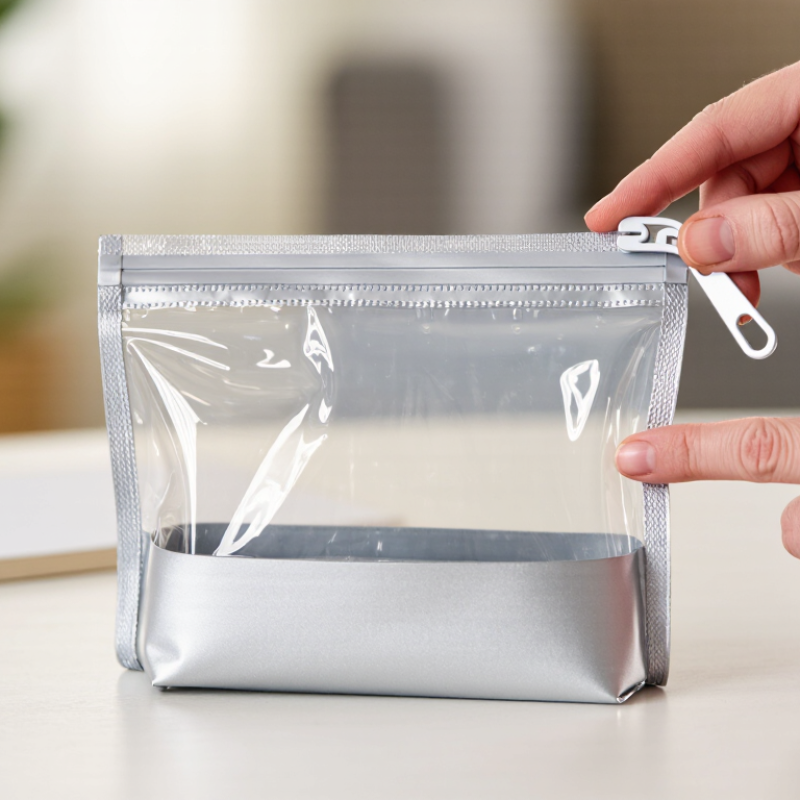
Definition and Purpose of a Child-Resistant Zipper Pouch
A child-resistant zipper pouch is a flexible package with a closure designed to make opening more difficult for young children. Unlike a standard press-to-close zipper, it may require a particular sequence, such as pressing two points while pulling a tab. The exact action depends on the pouch design. Small details matter: a clear instruction panel, a firm grip area, and a zipper that fully engages can all affect how the package works.
Its purpose is to reduce the chance of a child opening the pouch by accident while allowing adults to access it when needed. “Child-resistant” does not mean childproof. A determined child may still succeed, and an adult unfamiliar with the closure may need a moment to learn it. That is worth considering. Good design balances resistance with practical use, and packaging should be evaluated through appropriate testing rather than appearance alone. Keep stored items out of children’s reach, close the zipper completely after use, and follow the package instructions. A pouch adds a layer of protection; it cannot replace careful storage or adult supervision.
Key Components and Materials
A child resistant zipper pouch uses a closure that takes more effort and coordination to open than a standard press-to-close zipper. Common designs require a user to press specific points while sliding the zipper, or to align and squeeze the tracks. The pouch may also include a reinforced zipper area, a tear notch, and clear opening instructions. Small details matter. If the zipper feels too stiff or the instructions are hard to see, adults may struggle too.
The pouch body is often made from flexible plastic film, such as layered polyethylene and polyester. Each layer has a role: one can provide strength, while another helps seal the pouch or limit moisture and odor transfer. Some designs add a foil or barrier layer, though this can reduce visibility of the contents. Material choice depends on the product, storage conditions, and needed durability. A thick pouch is not automatically a better pouch; poor seals can still fail. Real testing matters.
Tips: Check that the zipper closes evenly from corner to corner, and look for gaps or wrinkled seals. Try opening and closing a sample with dry hands, then with slightly damp fingers. That small test can reveal awkward handling. Child resistant does not mean childproof, so store the pouch securely and follow its use instructions.
| Component or feature | Common materials or construction | Function | Important consideration |
|---|---|---|---|
| Pouch body | Flexible multilayer film, often combining polyester (PET), polyethylene (PE), and, where needed, aluminum foil or a metallized layer | Holds the contents and provides a barrier against moisture, oxygen, light, or odors, depending on the film structure | Barrier performance varies by material combination, thickness, and seal quality. |
| Child-resistant closure | A specially designed zipper or closure system made from compatible plastics, commonly polyolefin-based materials | Requires a deliberate opening action that is more difficult for young children than a standard press-to-close zipper | A child-resistant design is not the same as a child-proof design. |
| Opening mechanism | May use a push-and-slide, pinch-and-pull, or other coordinated-action design | Adds an opening step intended to make access less intuitive for children | The specific action depends on the closure design; users should follow the printed opening instructions. |
| Closure track and profile | Interlocking plastic profiles formed as part of, or attached to, the zipper assembly | Creates a reclosable seal when the profiles are properly engaged | Closure performance can be affected by debris, misalignment, wear, or incomplete engagement. |
| Top seal and side seals | Heat-sealed areas where compatible pouch-film layers are joined | Close the pouch perimeter and help prevent leakage or unintended access around the closure | Seal strength depends on film compatibility and controlled sealing conditions. |
| Tear notch or opening aid | A die-cut notch or other feature in the pouch film | Can help an adult open the package before first use | Its placement should not compromise the closure or create an unintended access point. |
| Printed instructions | Ink printed directly on the pouch or on an applied label | Explains how to open and reclose the pouch and may provide storage or safety information | Instructions support proper use but do not replace a tested child-resistant design. |
| Child-resistance testing | Testing of the complete package configuration, including its closure and opening method | Evaluates child resistance and, where applicable, adult accessibility under the relevant testing protocol | In the United States, applicable special packaging requirements are set out in 16 CFR 1700.20. Requirements vary by product and jurisdiction. |
| Overall safety | A pouch’s performance depends on the assembled package, its contents, use, and storage | The closure is intended to reduce the risk of access by children | Keep contents out of children’s reach. Child-resistant packaging does not eliminate the risk of accidental access. |
How the Child-Resistant Closure Works
What Is a Child Resistant Zipper Pouch?
How the Child-Resistant Closure Works
A child-resistant zipper pouch uses a closure designed to require more than a simple pull. Many styles have small tabs or marked pressure points beside the zipper. An adult presses these areas inward while sliding the zipper open. The coordinated movement can be harder for young children to manage, especially when their fingers are small.
The pouch may feel stiff at first. You might need to pinch both sides firmly, then move the slider along the top seam. Listen for the zipper track separating, and check that the opening is wide enough before reaching inside. Different designs work differently, so follow the directions printed on the package. A closure that looks similar may use another motion.
It is not foolproof. Children develop at different rates, and repeated use can wear down a zipper or its seams. If the pouch no longer closes securely, replace it rather than relying on appearance alone. I also find that a tight seal can be awkward for adults with limited hand strength; that trade-off is worth noticing. Keep the pouch closed and stored out of children’s reach, even when its closure is functioning properly.
Common Uses and Product Types
Child-resistant zipper pouches are flexible bags with closures designed to make opening harder for young children while remaining usable by adults. Common designs require two actions, such as pressing marked tabs while pulling the zipper apart. They are used for products such as vitamins, over-the-counter medicines, and household cleaning supplies. The pouch may be flat for compact storage or stand upright with a gusseted base. Some have opaque layers for light protection; others include a clear window for quick product checks.
Material and closure choice matter. A zipper pouch can be resealable, but that does not automatically make it child-resistant; performance depends on the complete package design. The Flexible Packaging Association’s 2023 State of the U.S. Flexible Packaging Industry Report valued the sector at $42.9 billion in 2022, reflecting the broad use of flexible formats—not child-resistant pouches alone. In practice, users should check that the closure fully engages after each opening. Not foolproof. The extra steps can frustrate adults with limited dexterity, and small tabs may be difficult to grip. That trade-off deserves attention when choosing a pouch for everyday use.
Safety Testing, Limitations, and Proper Handling
What Is a Child Resistant Zipper Pouch?
Safety Testing, Limitations, and Proper Handling
A child-resistant zipper pouch is designed to make opening harder for young children, while remaining usable for adults. It is not childproof. Small differences in hand strength, coordination, and experience can affect how a pouch performs. That distinction is easy to overlook.
Safety testing should follow a defined protocol under controlled conditions. Depending on the protocol, assessments may examine whether children can open the pouch and whether adults can use it. Qualified testing is more reliable than trying it informally at home. A pouch may also need checks for zipper function, seal integrity, and performance after repeated opening. Results apply to the tested design and conditions; they do not guarantee that every pouch will stay secure in daily use. Real handling can be messier.
Close the zipper fully, following the pouch’s instructions, and check that the closure is engaged across its entire length. Look for torn seams, worn tracks, or parts that no longer align. Replace a damaged pouch rather than relying on it. Keep it out of children’s reach, even when closed, and maintain adult supervision. These steps are easy to miss when routines get busy. A resistant closure adds a layer of protection, not a substitute for careful storage.
What Is a Child-Resistant Zipper Pouch?
U.S. child-resistant packaging test benchmarks in 16 CFR § 1700.20
How to read this: These are U.S. protocol pass thresholds, not a guarantee that every zipper pouch is child-resistant. The child and adult results come from different test groups and test steps. A pouch must be evaluated in its final package configuration; a zipper alone does not establish child resistance.
Handling: Close the zipper fully after each use and store the pouch securely out of children’s reach. Follow the product’s specific storage instructions.