
Top Metal Railings Suppliers for Global Buyers?
Metal Railings may look like a simple finishing choice, but their performance depends on material, fabrication, and installation details. A balcony guard, a stair handrail, and a coastal walkway railing face different loads and exposure. Buyers comparing global suppliers should therefore assess the intended application before comparing prices.
The scale of the metal industry offers useful context, though it does not measure railing demand directly. The World Steel Association’s World Steel in Figures 2024 reports global crude steel production of about 1.89 billion tonnes in 2023. That figure reflects a vast supply base, not a guarantee of consistent product quality. Details matter. Buyers should request clear drawings, material specifications, finish descriptions, and inspection records. For outdoor projects, ask how suppliers address corrosion, drainage, and coating damage during transport.
A dependable supplier comparison goes beyond a polished catalogue. Check manufacturing capacity, sample quality, packaging, lead-time assumptions, and the process for resolving defects. Confirm that quoted dimensions and connection details match the project drawings. Where applicable, have qualified local professionals review design and installation requirements. Evidence of quality systems can help, but it does not replace project-specific checks. Not always. Supplier claims may be difficult to compare when test methods or documentation differ. This guide examines what global buyers can verify, which questions reveal practical capability, and where a low initial quote may leave important costs unclear. It also recognizes a limitation: public industry reports rarely isolate metal railing production, so purchasing decisions still require direct, documented supplier evidence.
Understanding the Role of Metal Railing Suppliers
Metal railing suppliers do more than sell posts, panels, and handrails. They help buyers turn drawings into components that can be manufactured, packed, and installed. A dependable supplier asks about railing height, fixing points, indoor or outdoor exposure, and the project’s expected use. These details affect material selection, finish, fabrication, and fit. Stainless steel, aluminum, and coated carbon steel each suit different conditions. The right choice depends on the site, maintenance plan, and design requirements. A polished catalogue is not enough. Buyers should also review sample finishes, fabrication drawings, inspection records, and realistic lead times. For project-specific safety requirements, consult a qualified local professional.
Tips: Send dimensioned drawings and clear photos of the installation area. Ask how tolerances, surface protection, and packaging are handled. Confirm what inspection documents are available before production begins.
A supplier’s role continues after the order is placed. Clear updates can help buyers spot drawing errors before metal is cut. They can also coordinate bundle labels and packing details, making identification easier when a shipment reaches a busy site. Still, communication can be imperfect, and a supplier may not know every site constraint. Share changes promptly and keep approved drawings on record. This extra care may feel slow, but it can prevent costly rework and mismatched parts.
Common Railing Materials, Designs, and Applications
Metal railings are commonly made from stainless steel, galvanized steel, or aluminum. Stainless steel suits clean, modern interiors and many outdoor settings, though coastal salt can still stain some finishes. Galvanized steel offers a sturdy option for busy walkways, while aluminum is lighter and easier to handle on balconies. Finish matters. Ask how edges, joints, and cut ends are protected, since these areas can wear first.
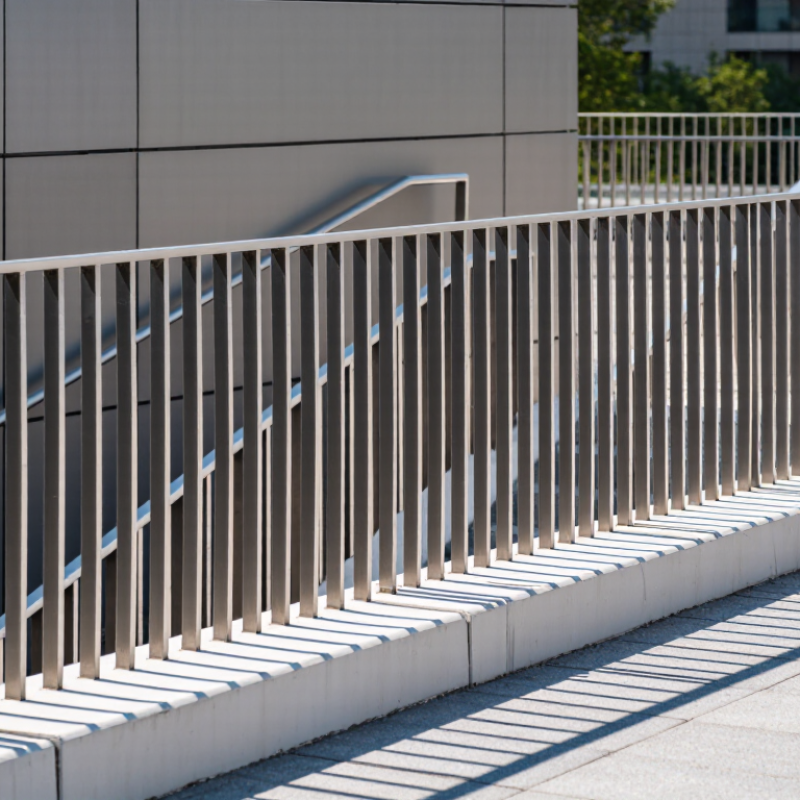
Design affects both appearance and daily use. Vertical bars create a familiar, open look and are often practical for stairs and terraces. Cable infill keeps sightlines clear, but its tension and fixing points need careful installation. Glass panels admit more light and block wind, yet fingerprints and cleaning access can become regular annoyances. No design is maintenance-free. A sample section can reveal details that a drawing misses.
Applications range from residential stair rails to perimeter barriers around commercial buildings. Stairways need a comfortable, continuous handhold; balcony systems need secure posts and well-fitted infill. In wet or salty climates, drainage around base plates and suitable corrosion protection deserve attention. Buyers should compare drawings, finish specifications, and installation guidance, then confirm applicable load and opening requirements for the project location. Small details matter. A polished rail can still disappoint if its anchors do not match the supporting structure.
Top Metal Railings Suppliers for Global Buyers? - Common Railing Materials, Designs, and Applications
| Material | Common Designs | Typical Applications | Corrosion Resistance | Maintenance Considerations | Buyer Notes |
|---|---|---|---|---|---|
| Carbon steel | Welded vertical bars, horizontal rails, ornamental patterns | Stairs, balconies, platforms, industrial walkways | Low without protective coating; improved by galvanizing and/or a suitable paint system | Inspect coatings and joints; repair damaged areas to limit rust | Confirm steel grade, coating specification, weld quality, and required exposure category |
| Hot-dip galvanized steel | Post-and-rail, welded mesh infill, modular guardrails | Outdoor stairs, bridges, public facilities, warehouse platforms | Zinc coating provides a protective barrier and sacrificial protection; service life varies with environment and coating thickness | Usually low; check for coating damage, drainage issues, and corrosion at cut edges | Specify the applicable galvanizing standard and whether additional paint or powder coating is required |
| Stainless steel 304 | Round or square posts, tube-and-rail systems, cable infill | Interior stairs, commercial buildings, sheltered outdoor areas | Good general corrosion resistance in many inland and indoor settings; less suitable than 316 for chloride-rich exposure | Clean periodically; avoid contaminating the surface with carbon-steel tools or residues | Check the stated alloy grade and surface finish; appearance alone cannot verify stainless grade |
| Stainless steel 316 | Marine-grade posts, glass-clamp systems, cable or rod infill | Coastal buildings, marinas, pool areas, exposed outdoor locations | Generally better resistance to chloride pitting than 304; not immune to corrosion | Rinse salt deposits and clean regularly, especially in coastal or pool environments | Confirm the alloy of the complete system, including fasteners and fittings |
| Aluminum | Extruded picket rails, framed panels, modular balcony systems | Residential balconies, terraces, ramps, light-duty outdoor settings | Good atmospheric corrosion resistance; coating choice and dissimilar-metal contact matter | Generally low; clean surfaces and inspect coatings and connections | Compare alloy, temper, section design, finish, and engineering for the required loads |
| Wrought iron / wrought-iron-style steel | Decorative scrolls, forged balusters, custom ornamental panels | Heritage properties, entrance steps, gardens, decorative balconies | Requires a protective coating; performance depends on preparation, coating, and exposure | Inspect decorative joints and coating; touch up chips before corrosion spreads | Clarify whether the product is traditional wrought iron or modern steel made in a wrought-iron style |
| Metal frame with glass infill | Post-supported glass panels or base-shoe systems | Balconies, terraces, staircases, view-facing decks | Depends on frame and hardware material; glass itself does not rust | Clean glass and inspect seals, clamps, fixings, and drainage details | Verify safety-glass type, panel thickness, edge treatment, and system-specific structural testing |
Selection reminder: Railing dimensions, infill openings, guard heights, load requirements, and permitted materials vary by jurisdiction and building use. Confirm local building codes and project specifications before ordering.
How to Evaluate Suppliers for Quality and Compliance
For global buyers, a railing supplier’s certificate is a starting point, not a quality verdict. The ISO Survey of Management System Standard Certifications recorded over 1.2 million valid ISO 9001 certificates worldwide in 2022. That scale shows how common quality systems are; it does not prove that a particular railing meets your project requirements. Ask for the supplier’s current certificate, its scope, and the issuing body. Then compare those details with actual production records.
Request material certificates linked to heat numbers, weld inspection records, and dimensional checks for posts, rails, and openings. For galvanized or painted steel, specify the coating standard and request measured coating-thickness results from the production batch. Confirm that test methods and acceptance limits match the destination market’s building code and project specifications.
Paperwork is not proof. Select a sample order and check measurements, surface finish, and traceability before approving full production.
One detail is easy to miss: a factory may hold a valid quality certificate while subcontracting critical coating work. Ask who performs each process, how changes are controlled, and whether inspection records cover subcontractors. When evidence is incomplete, pause and clarify rather than assuming compliance.
Comparing Global Sourcing, Pricing, and Delivery Options
For global buyers, railing quotes should be compared on the same specification, not just price per metre. List alloy or steel grade, post spacing, finish, fixing hardware, and packing method. A cheaper quote can omit anchors or protective wrapping. Ask suppliers to price the same drawings and state whether inspection, export packing, and inland transport are included. Small details matter. Samples help, but a short sample rarely shows how a long railing run will fit on site.
Delivery needs its own comparison. UNCTAD’s Review of Maritime Transport 2024 reports that maritime trade grew 2.4% in 2023, while disruptions continued to affect shipping routes and costs. Request separate production and transit estimates, plus the named delivery term and destination port. The World Bank’s Logistics Performance Index 2023 assesses customs, infrastructure, tracking, and timeliness; these factors can shape the reliability of a shipment as much as distance. Steel input costs also move: worldsteel’s October 2024 outlook projected global steel demand at 1,751 million tonnes in 2024 and 1,772 million tonnes in 2025. That is context, not a railing price forecast. Compare payment stages, quote validity, and remedies for damaged pieces. A tidy spreadsheet still cannot remove every delay.
Questions to Ask Before Choosing a Railing Supplier
Before comparing prices, ask how the supplier verifies material grade and finish. Request sample certificates and a clear description of the metal, coating, and surface preparation. For coastal projects, ask how the finish performs around salt spray and whether maintenance is required. A polished brochure is not evidence.
Ask for drawings that show post spacing, fixing points, weld details, and dimensions. How are loads and test results documented for the intended project? Confirm which standards apply at the destination, and ask who checks compliance. Small details matter. A few millimeters can complicate installation when posts meet uneven concrete. Ask whether production tolerances are stated in writing.
Clarify lead time, packaging, inspection steps, and what happens if parts arrive damaged or do not match the approved drawings. Can the supplier provide progress updates and replacement components? Ask for examples of similar projects, but verify references where practical. A supplier may answer confidently and still miss a site-specific issue. Share photos, measurements, and exposure conditions early, then request written confirmation of the final specifications.