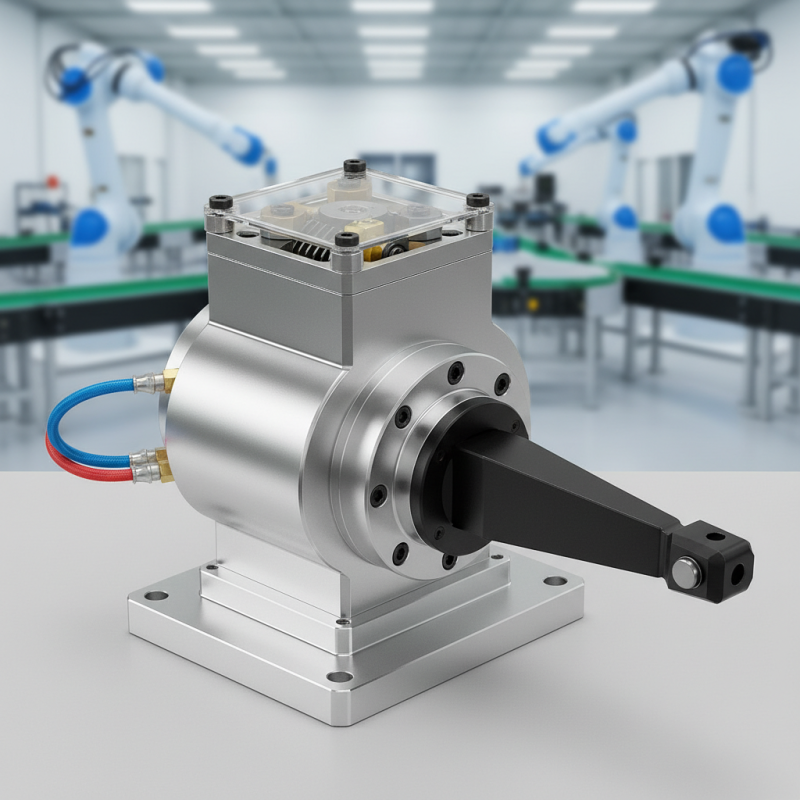
What is a 180 Rotation Rotary Actuator and How Does It Work?
A 180 Rotation Rotary Actuator is a crucial component in many mechanical systems. This device allows precise movement through a 180-degree rotation. Engineers often rely on it for automation tasks in various industries, from robotics to manufacturing.
Understanding how a 180 Rotation Rotary Actuator works can illuminate its broader applications. These actuators can streamline operations and improve efficiency. However, users must consider their limitations, such as the range of motion and load capacity.
The design is often straightforward. Yet, implementing this technology without adequate knowledge can lead to errors. Users should carefully analyze their specific needs to ensure the actuator fits the intended application. The balance between reliability and complexity is essential for optimal performance.
What is a Rotary Actuator and Its Applications?
Rotary actuators are devices that convert energy into rotational motion. They are widely used in various industries. For instance, you might find them in robotics, automotive systems, and even manufacturing equipment. These actuators enable precise control of movement, which is crucial for tasks requiring accuracy.
The applications of rotary actuators vary significantly. In robotic arms, they assist in precise manipulation. In HVAC systems, they control dampers for airflow regulation. However, some challenges exist. For example, ensuring reliable operation under different conditions can be tricky. Sometimes, these actuators may also require regular maintenance or recalibration.
Many factors affect their performance. Environmental conditions, wear and tear, and power supply issues can lead to failures. Designers must consider these variables when integrating rotary actuators. Failing to address them can result in unexpected downtime or inefficiency. So, while rotary actuators offer great benefits, they come with processes that require thoughtful management.
Understanding the Concept of 180-Degree Rotation
A 180-degree rotation rotary actuator is a device that enables precise movement. It can rotate an object halfway around a circle. This actuator is widely used in various applications, from robotics to aerospace. Its simple design allows for reliable performance in limited space.
Understanding the concept of 180-degree rotation is essential. The actuator can move from its starting point to an endpoint with great accuracy. It often uses electric motors or pneumatic systems to achieve this task. This movement can be linear or rotational, depending on the system's design.
However, there are challenges. Sometimes, the actuator may not reach the exact angle due to mechanical issues. Calibration is essential to ensure proper operation. Feedback systems help track the position but can be complex. Regular maintenance is needed to avoid potential failures. Managing these aspects effectively can lead to better outcomes.
Components of a 180 Rotation Rotary Actuator
A 180-degree rotation rotary actuator is a mechanical device. It converts a rotational movement into linear motion. The actuator plays a crucial role in various robotics and automation systems. Understanding its components helps us appreciate its functionality.
The main components include the motor, gears, and output shaft. The motor generates the initial force. It can be electric or pneumatic. Gears enhance torque and control the speed. They also change the motor's rotation into a suitable output for the task. The output shaft then delivers the required movement. This setup allows for precision in applications, such as in robotic arms or conveyor systems.
However, not all designs are perfect. Some actuators may face backlash issues. This affects accuracy. Maintenance is key. Regular checks on gears and motors can prevent failures. Designing an actuator demands careful consideration of components and their interactions. A small oversight can lead to inefficiency.
Mechanism of Action: How It Achieves Rotation
A 180 rotation rotary actuator is a mechanical device that provides precise angular motion. These actuators are critical in various applications, ranging from robotics to industrial machinery. The mechanism of action that enables their rotation is fascinating and complex.
At the core of a 180 rotation rotary actuator is a gear system that converts linear motion into rotational movement. When an electric current passes through the actuator, it energizes a motor. This motor drives components like gears or cam mechanisms. A report by BCC Research highlights that the global rotary actuator market is expected to grow, driven largely by advances in automation technologies.
The design ensures that the actuator can achieve exact angles, providing feedback mechanisms to confirm position accuracy. However, imperfections can arise. For example, the backlash in the gears can lead to slight deviations in movement. This aspect makes calibration essential. Engineers often find that smaller, more efficient designs can sometimes compromise on power or torque. Balancing these factors remains a challenge for developers in the field.
Common Use Cases and Industries Utilizing Rotary Actuators
Rotary actuators are crucial components in various industries. They offer precise movement and control, making them ideal for many applications. In manufacturing, rotary actuators help automate machinery. They enable quick and accurate positioning of tools and materials. This ensures efficiency and accuracy on factory floors.
In the automotive industry, these actuators play a vital role. They assist in various systems, like steering and throttle control. Their reliability is key for ensuring safety and performance in vehicles. Moreover, robotics also extensively use rotary actuators. They provide movement for robotic arms, increasing versatility in task execution.
**Tips:** When selecting a rotary actuator, consider your specific needs. Look for the required torque and speed ratings. Ensure compatibility with your existing systems for optimal performance. Regular maintenance is crucial, too. Over time, check for wear and tear to avoid unexpected failures.
Common Use Cases of 180 Rotation Rotary Actuators